
Overemployment in 2026: What the Numbers Actually Say
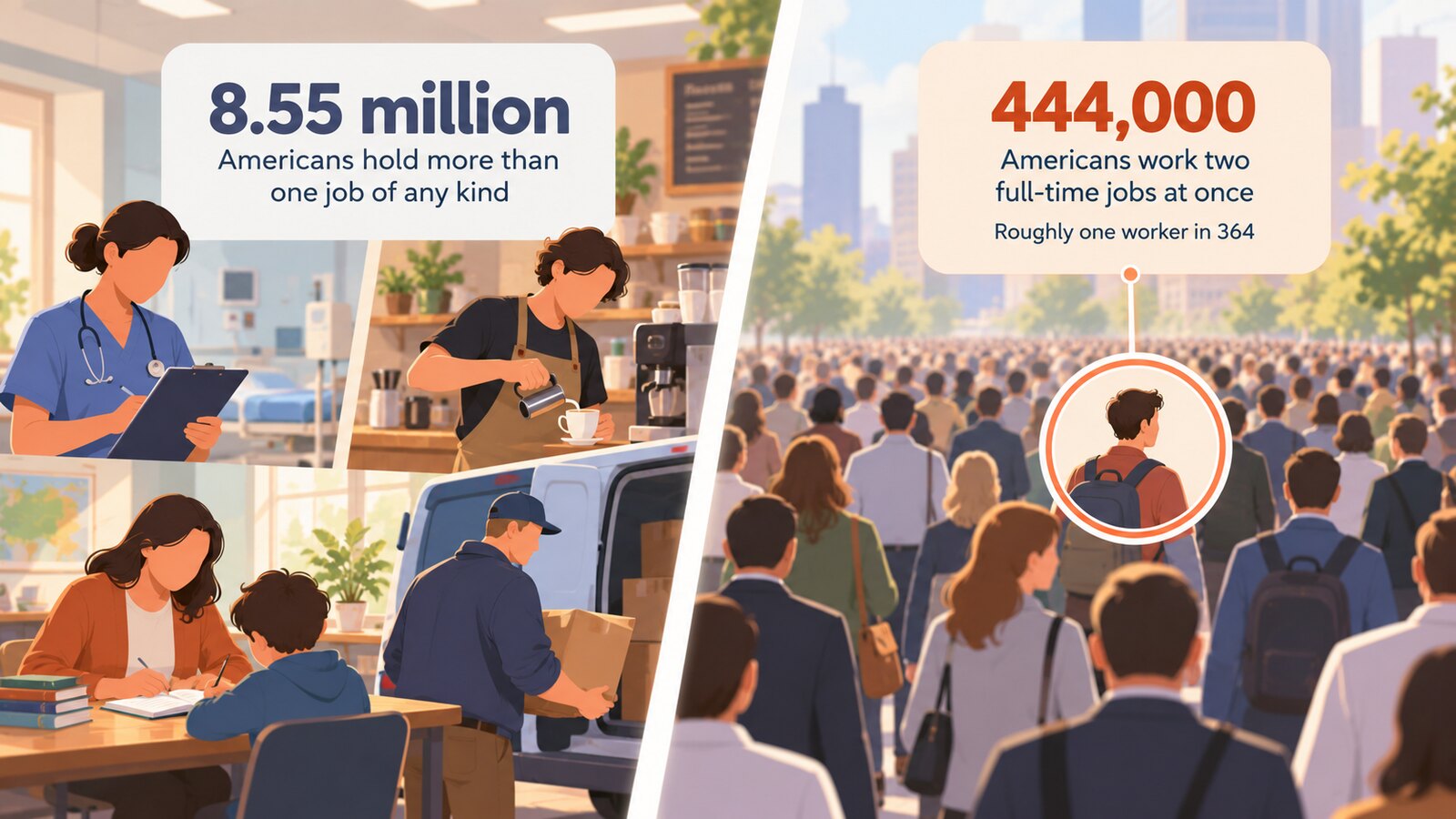
About 444,000 Americans currently work two full-time jobs at once. That is roughly one worker in 364 — and it is the number you actually want if you are worried about overemployment, because it is not the number you will see in the headlines.
The figure in circulation is 8.55 million, sometimes quoted at its November 2025 record of 9.29 million. That number is real, it comes from the Bureau of Labor Statistics, and it describes something quite different: everyone holding more than one job of any kind. A nurse picking up weekend shifts. A teacher tutoring on Saturdays. A warehouse worker driving for a delivery app on Sundays. Those are multiple jobholders. They are not what anyone means by overemployment.
We sell time tracking software with monitoring features, so it would suit us commercially to tell you that secret dual employment is an epidemic sweeping remote teams. The data does not support that, and we would rather give you the real figures than sell you a panic. The real figures are more interesting anyway, because they contain a genuine trend underneath a badly reported headline.
The three numbers, and why only one of them is about overemployment
BLS publishes multiple jobholding as several different series. Three matter here, all figures for June 2026:
- 8,554,000 — total multiple jobholders. Anyone with more than one job.
- 5.3% — those multiple jobholders as a share of everyone employed.
- 444,000 — people whose primary and secondary jobs are both full time. This is the overemployment population.
That last series is the one nobody quotes, and it is the only one that describes the scenario employers are actually anxious about: someone holding down two full-time roles simultaneously, at least one of which does not know about the other.
444,000 is 5.2% of all multiple jobholders. Put another way: for every hundred people you read about in a "9 million Americans work multiple jobs" headline, roughly five are working two full-time jobs. The other ninety-five have a side gig.
The rate is lower than it was in the 1990s
 Learn how SCREENish saves you money
Time tracking with screenshots, honest reports and hands-off payroll. Free to try — no credit card.
Start free →
Learn how SCREENish saves you money
Time tracking with screenshots, honest reports and hands-off payroll. Free to try — no credit card.
Start free →
Here is the part that should make you suspicious of every alarmed article on this subject.
Multiple jobholding as a share of employment was 5.89% in 1994. It peaked at 6.5% in November 1996. Today it is 5.3%. On the measure that actually adjusts for the size of the workforce, moonlighting is less common now than it was thirty years ago.
| Year | Multiple jobholders, % of employed |
|---|---|
| 1994 | 5.89% |
| 1996 (peak) | 6.19% annual, 6.5% single month |
| 2005 | 5.32% |
| 2010 | 4.95% |
| 2015 | 4.88% |
| 2019 | 5.11% |
| 2020 | 4.51% |
| 2024 | 5.22% |
| 2025 | 5.40% |
| 2026 (to June) | 5.20% |
The reason the raw count keeps setting records while the rate does not is unglamorous: the United States has more workers than it used to. A record number of people hold two jobs in the same sense that a record number of people own shoes. The denominator grew.
The 2020 dip is worth noticing too. Multiple jobholding fell to 4.0% in April 2020, its lowest reading in the entire series. Second jobs are disproportionately in hospitality, retail and personal services — precisely the work that vanished first. That is a useful reminder that this statistic tracks the availability of casual work at least as much as it tracks anyone's ambition.
But the full-time-plus-full-time number really is climbing
Having deflated the headline, here is the finding that survives scrutiny, and it is the one that should interest employers.
The population working two full-time jobs has grown substantially since before the pandemic:
| Year | Both jobs full time (annual average) |
|---|---|
| 1994 | 242,000 |
| 2005 | 294,000 |
| 2015 | 242,000 |
| 2019 | 307,000 |
| 2021 | 358,000 |
| 2023 | 392,000 |
| 2025 | 418,000 |
| 2026 (to June) | 412,000 |
Against the 2019 average, 2026 is running about 34% higher. The series hit an all-time high of 488,000 in December 2025. For a series that spent 1994 through 2015 wandering sideways around 240,000–290,000, a sustained third above its pre-pandemic level is a real break in behaviour.
So both things are true at once, which is why this subject gets reported so badly:
- Moonlighting overall is not at historic highs once you adjust for workforce size.
- Holding two full-time jobs specifically is up by roughly a third since 2019 and recently hit a record.
The obvious explanation is that remote work removed the physical constraint. You cannot be in two offices at once. You can be in two Slack workspaces at once. Nothing in the BLS data proves that causal link — the survey does not ask whether either job is remote — so treat it as the most plausible reading rather than an established fact.
What this means if you employ remote people
Take the number seriously in the right direction. One in 364 is not an epidemic. It is also not zero, and it is growing.
For a team of 20, the base rate suggests you would expect roughly one such person every eighteen teams. You almost certainly do not have one. For a team of 200, you would expect around one every other company of that size. Somewhere in the low hundreds of employees, "probably nobody" turns into "plausibly one person, occasionally".
Those are population base rates, not predictions about your company. Overemployment concentrates in exactly the roles that are fully remote, individually measured, and hired quickly — software, support, data work. If that describes your whole team, your odds are worse than the base rate. If you run a hybrid office team, they are better.
The practical consequence of a low base rate is a statistical trap that catches a lot of managers. When the underlying thing is rare, most of the signals that look like it will be false positives. If you flag people on a suspicion that is right one time in ten, on a 200-person team you will accuse roughly nineteen innocent people to find one real case. The rarer the behaviour, the more damage an aggressive detection policy does relative to what it catches.
Which is why the correct response to these numbers is not surveillance escalation. It is:
- Measure output, not presence. If someone is delivering a full-time workload to a good standard, the question of what else they do is a contractual matter, not a productivity one.
- Read your contracts before your dashboards. Exclusivity, conflict of interest and moonlighting clauses vary enormously and many are unenforceable in some jurisdictions. Know what you have actually agreed before you investigate anything.
- Treat evidence as a prompt for a conversation. Anomalies in tracked time are a reason to ask a question. They are not proof, and no automated system should be allowed to produce a verdict.
What tracked-time data can and cannot tell you
Since we build this software, here is an honest account of what it does on this specific question.
Time tracking with screenshots and activity levels shows you what happened on the machine during tracked hours. That reliably surfaces faked activity — mouse jigglers, auto-clickers and synthetic input — because that leaves a recognisable signature. It shows you idle patterns, and it shows you which programs and sites were open during work time.
What it cannot see is a second employer. It has no visibility into another company's systems, and it never will. Overemployment is inferred from indirect signals: implausible activity patterns, work happening at hours that conflict with the agreed schedule, or a device inventory that does not match the story. Every one of those has innocent explanations. A parent doing school pickup and making the hours up at night looks statistically similar to someone servicing a second job.
Two features worth knowing about if this is your concern:
- Faked-activity detection flags synthetic input into a review queue for a human decision. It never issues an automatic accusation, and that design choice is deliberate — see how mouse jiggler detection works.
- Face verification confirms the person tracking time is the person you hired, against a manager-approved photo and with explicit GDPR-grade consent. It answers "is this the right human", not "does this human have another job" — see face recognition time tracking.
If you want the broader picture of which signals are worth watching, we have written that up separately on overemployment detection for remote teams.
The summary, if you only take one thing
The 9-million figure is not about overemployment. The overemployment figure is 444,000, or about 1 in 364 workers. It has grown roughly 34% since 2019 and set a record of 488,000 in December 2025, while the broader multiple-jobholding rate remains below where it sat in the 1990s.
That is a real trend on a small base. It justifies knowing what your contracts say and having a defensible way to look into a genuine anomaly. It does not justify treating your team as suspects, and any vendor — us included — who uses the 9-million number to sell you monitoring is quoting a statistic that does not mean what they are implying it means.
Sources and methodology
All figures are from the U.S. Bureau of Labor Statistics Current Population Survey, retrieved via FRED (Federal Reserve Bank of St. Louis) on 21 July 2026. Latest observation in every series is June 2026, published 2 July 2026.
- Multiple Jobholders, Primary and Secondary Jobs Both Full Time (LNU02026631) — thousands of persons, not seasonally adjusted.
- Multiple Jobholders as a Percent of Employed (LNS12026620) — percent, seasonally adjusted.
- Multiple Jobholders (LNS12026619) — thousands of persons, seasonally adjusted.
Annual figures are averages of monthly observations; 2026 covers January to June only. The "1 in 364" ratio divides the both-full-time count by total employment implied by the headline count and its published rate (about 161.4 million). Because the both-full-time series is not seasonally adjusted while the others are, single-month comparisons between them carry some noise — the annual averages are the sounder basis for the trend claims, and that is what the 34% figure uses.
One limitation worth stating plainly: the CPS asks people to describe their own working arrangements. Anyone deliberately concealing a second full-time job from an employer has some incentive to conceal it from a government survey too. If that effect is meaningful, 444,000 is an undercount by an unknown margin. We have no way to size that, and neither does anyone else quoting these numbers.